
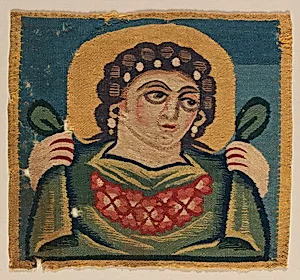
Tabula (Square) with the Head of Spring
Unknown Artist
5th–7th century
Medium
Linen, wool
Dimensions
Textile: H. 9 1/4 in. (23.5 cm) W. 9 13/16 in. (25 cm) Mount: H. 15 5/8 in. (39.7 cm) W. 15 5/8 in. (39.7 cm) D. 1 3/8 in. (3.5 cm)
Classification
Textiles
Department
Islamic Art
Museum
Metropolitan Museum of Art, New York, NY
Credit
Gift of George F. Baker, 1890
Accession Number
90.5.848
Rights
Public Domain
Tags
Art Historical Context
This delicate textile square, known as a *tabula*, dates to the 5th–7th century and showcases the Head of Spring, likely personified as a graceful female figure. Crafted from linen and wool, it measures about 9¼ by 9⅞ inches, exemplifying early techniques in tapestry weaving where colorful wool yarns create vivid patterns against a fine linen ground. Such small panels were prized decorative elements, often sewn into garments, cushions, or hangings, blending utility with artistry. In the context of early Islamic art, this piece reflects the rich fusion of Late Antique traditions from Egypt and the Near East, where classical motifs like seasonal personifications endured. The Head of Spring evokes renewal and fertility, a timeless symbol drawing from Greco-Roman and Sasanian influences, adapted into the emerging Islamic world. Textiles like this were everyday luxuries, highlighting women's roles in production and the cultural value of woven art. A generous gift to the Metropolitan Museum of Art in 1890 by George F. Baker, it invites us to appreciate the anonymous craftsperson's skill and the enduring beauty of these ancient fabrics.