
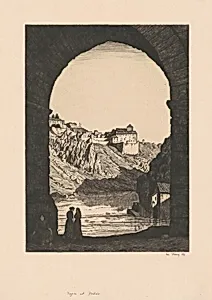
Tagus at Toledo
1913
Medium
etching in black on laid paper
Dimensions
plate: 31.59 × 22.86 cm (12 7/16 × 9 in.) sheet: 43.82 × 31.12 cm (17 1/4 × 12 1/4 in.)
Classification
Department
CG-W
Museum
National Gallery of Art, Washington, D.C.
Credit
Corcoran Collection (Bequest of Frank B. Bristow)
Accession Number
2015.19.1403
Rights
Public Domain
Art Historical Context
Ian Strang's *Tagus at Toledo* (1913) captures the majestic curve of Spain's Tagus River as it winds through the historic city of Toledo, a UNESCO World Heritage site famed for its layered Islamic, Jewish, and Christian architecture. during Strang's travels abroad, this etching reflects the early 20th-century British with continental landscapes, evoking the atmospheric precision of James McNeill Whistler, whom Strang admired. As a Scottish artist and prominent etcher, Strang contributed to the etching revival, blending meticulous linework with tonal subtlety to convey the river's reflective calm and the distant city's silhouette. Etched in black ink on laid paper—a traditional support with visible chain lines that enhances the print's tactile authenticity—the work measures a modest plate size of 31.59 × 22.86 cm. Etching allowed Strang to achieve delicate gradations through aquatint-like textures and fine incisions on a metal plate, bitten by acid for depth and richness. This intaglio technique was prized for its reproducibility, making fine art accessible beyond paintings. Now part of the National Gallery of Art's Corcoran Collection (Bequest of Frank B. Bristow), *Tagus at Toledo* exemplifies Strang's mastery in printmaking, inviting visitors to ponder the timeless interplay of water, stone, and light in one of Europe's most storied vistas.