
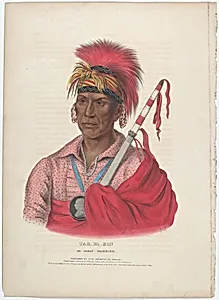
Tah-Ro-Hon, An Ioway Warrior
Medium
hand-colored lithograph on wove paper
Dimensions
sheet: 52.07 × 36.83 cm (20 1/2 × 14 1/2 in.)
Classification
Department
CG-W
Museum
National Gallery of Art, Washington, D.C.
Credit
Donald and Nancy deLaski Fund
Accession Number
2012.141.1
Rights
Public Domain
Art Historical Context
**Tah-Ro-Hon, An Ioway Warrior** a striking hand-colored lithograph created in 1838 by Alfred Hoffy based on an original portrait by Charles Bird King. Measuring 20½ × 14½ inches, this print captures the dignified profile of Tah-Ro-Hon, a warrior from the Ioway (Iowa) tribe, adorned in traditional regalia that highlights his cultural identity and status. Housed in the National Gallery Art's collection, thanks to the Donald and Nancy deL Fund, it exemplifies 19th-century efforts to document Native American leadersThis artwork stems from a pivotal moment in American history: the early 1830s Indian removal policies. King's portraits, commissioned for the Bureau of Indian Affairs, were part of Thomas L. McKenney's ambitious *History of the Indian Tribes of North America* project. Hoffy's lithograph faithfully reproduces King's neoclassical style, emphasizing realistic features and symbolic attire amid the era's tensions between expansionism and indigenous sovereignty. The medium—hand-colored lithography on wove paper—was revolutionary for its time, enabling affordable, vivid reproductions of fine art. Artisans meticulously applied watercolors by hand, bringing Tah-Ro-Hon's image to life with rich tones that preserve cultural details otherwise at risk of fading into history. A poignant window into vanishing traditions, it invites visitors to reflect on resilience and representation.