
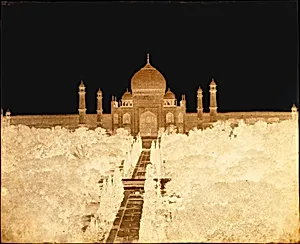
Taj Mahal and Gardens
ca. 1855
Medium
Waxed paper negative
Dimensions
38.5 x 47.2 cm (15 3/16 x 18 9/16 in.)
Classification
Negatives
Department
Photographs
Museum
Metropolitan Museum of Art, New York, NY
Credit
The Rubel Collection, Purchase, Anonymous Gift and Cynthia Hazen Polsky Gift, 1997
Accession Number
1997.382.57
Rights
Public Domain
Tags
Art Historical Context
Behold the ethereal "Taj Mahal and Gardens a waxed paper negative captured around 1855 by pioneering photographer John Murray. This stunning image preserves one of the world's most iconic monuments—the Taj Mahal, Emperor Shah Jahan's 17th-century marble maus built as a tribute to his beloved wife, Mumtaz Mahal. Nestled amid its symmetrical gardens in Agra, India, the structure gleams with otherworldly grace, its domes and minarets framed against the landscape in Murray's masterful composition. Crafted via the calotype process, this 38.5 x 47.2 cm negative represents an early triumph of photography. Murray waxed silver-sensitized paper to create a translucent base, allowing light to imprint a detailed, one-of-a-kind negative from which positive prints could be made. Active during the British colonial era in India, Murray was among the first to document Mughal architecture photographically, blending technical innovation with a keen eye for monumental beauty. Housed in The Metropolitan Museum of Art's Photographs Department from The Rubel Collection, this work highlights photography's power to immortalize cultural treasures. It invites us to ponder the Taj's timeless allure through 19th-century eyes, bridging empires and eras in a single, haunting frame.