
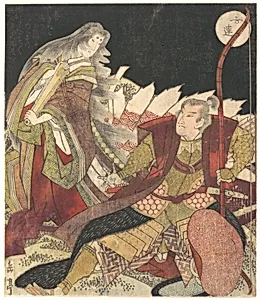
Tamamo no Mae and the Archer Miura Kuranosuke
Yashima Gakutei, 1835
About this artwork
In this exquisite woodblock print from 1835, Osaka-based artist Yashima Gaki captures a dramatic moment from Japanese folklore: the enchantress Tamamo no Mae a legendary fox spirit disguised as a court lady, confronted by the skilled archer Miura Kuruke. Created during Japan's Edo period (16151868), the work is a *surimono*—a luxurious, privately commissioned print often produced for New Year's greetings or poetry gatherings. Measuring just 7⅞ × 8¾ inches, its intimate scale and vibrant ink-and-color-on-paper technique highlight Gakutei's mastery of fine lines and subtle gradations, evoking tension through the archer's drawn bow and the fox-woman's poised allure. Tamamo no Mae's tale, drawn from medieval legends like the *Tamamo-no-Mae Sōshi*, warns of deception and supernatural mischief; she bewitched Emperor Toba before her true nature was revealed, leading to her pursuit by warriors like Miura. Gakutei's depiction blends ukiyo-e traditions of "pictures of the floating world" with mythological drama, using tags like "Bow and Arrow," "Men," and "Women" to emphasize gender dynamics and weaponry as symbols of confrontation. Housed in the Metropolitan Museum of Art's Asian Art Department, this gift from the Estate of Samuel Isham exemplifies surimono's cultural prestige—prized for their embossing, mica accents, and poetic elegance. It offers visitors a window into Edo Japan's blend of artistry, storytelling, and superstition.