
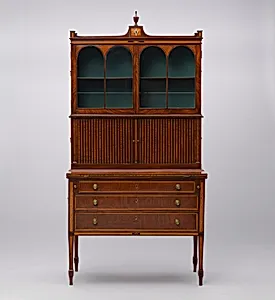
Tambour Desk and Bookcase
c. 1800
Medium
Mahogany, satinwood, white pine, cherrywood, chestnut, with brass, ivorine, and leather
Dimensions
Closed: 188 × 95.3 × 49.6 cm (74 × 37 1/2 × 19 1/2 in.); Open: 188 × 95.3 × 73.7 cm (74 × 37 1/2 × 29 in.)
Classification
furniture
Department
Arts of the Americas
Museum
Art Institute of Chicago
Accession Number
272490
Rights
Public Domain
Art Historical Context
This elegant Tambour Desk and Bookcase, crafted around 1800 by the Boston cabinetmakers John and Thomas Seymour, exemplifies the refined Federal style that flourished in early America. The Seymours, celebrated for their precise joinery and sophisticated designs, created this multifunctional piece as both a practical writing desk and a storage solution for books and papers. Its tambour doors—flexible shutters made of narrow wooden slats—slide smoothly to reveal an interior workspace, showcasing the innovative mechanics popular in the period. The desk’s rich materials highlight the Seymours’ mastery of contrasting woods and fine details. Mahogany and satinwood provide a luxurious surface, accented by brass fittings, ivorine inlays, and a leather writing surface. Such combinations were prized for their beauty and durability, reflecting the growing prosperity of American merchants and the influence of European neoclassical tastes adapted to local workshops. Housed in the Art Institute of Chicago’s Arts of the Americas collection, this furniture stands as a testament to the skill of early national craftsmen. It offers visitors a glimpse into how everyday objects blended utility with artistic elegance at the dawn of the nineteenth century.