
Tankard
Unknown Artist
18th century
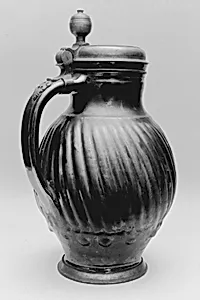
Medium
Salt-glazed stoneware; pewter
Dimensions
Height: 11 in. (27.9 cm)
Classification
Ceramics-Pottery
Culture
German, Silesia (Bunzlau)
Department
European Sculpture and Decorative Arts
Museum
Metropolitan Museum of Art, New York, NY
Credit
Gift of Mrs. Robert W. de Forest, 1920
Accession Number
20.62.24
Rights
Public Domain
Art Historical Context
This elegant 18th-century tank hails from Bunzlau in Silesia (modern Bolesławiec, Poland a hub of German pottery production renowned for its robust stoneware. Standing at 11 inches tall it exemplifies everyday functional art from the region, where potters crafted durable vessels for communal drinking, especially beer—a staple of German social life. The anonymous artisan's work reflects the practical beauty of Silesian ceramics, blending utility with subtle craftsmanship in the European decorative arts tradition. Crafted from salt-glazed stoneware with a pewter lid and fittings, the tankard showcases a key 17th- and 18th-century technique. Salt glazing involved tossing salt into the kiln, where it vaporized to create a hard, glossy, glass-like surface—resistant to liquids and scratches, ideal for tavern use. This method, perfected in German-speaking regions, elevated humble pottery to export-worthy status, influencing broader European ceramics. Now in the Metropolitan Museum of Art's European Sculpture and Decorative Arts collection (gift of Mrs. Robert W. de Forest, 1920), this tankard invites us to appreciate the unsung makers of daily life. Imagine it foaming with frothy ale at a lively gathering— a tangible link to 18th-century conviviality.