
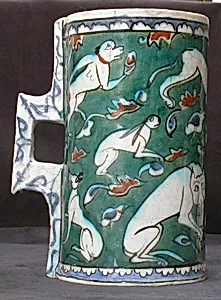
Tankard in Imitation of Metalwork Form
Unknown Artist
last quarter 16th century
Medium
Stonepaste; polychrome painted under transparent glaze
Dimensions
H. 7 5/8 in. (19.4 cm) Diam. without handle: 4 1/4 in. (10.8 cm) Diam. with handle: 5 3/4 in. (14.6 cm)
Classification
Ceramics
Department
Islamic Art
Museum
Metropolitan Museum of Art, New York, NY
Credit
H.O. Havemeyer Collection, Gift of Horace Havemeyer, 1940
Accession Number
40.181.2
Rights
Public Domain
Tags
Art Historical Context
This exquisite tankard, crafted in the last quarter of the 16 century, exemplifies the ingenuity of Islamic ceramic artists who mastered stonepaste—a fine, white fritware body that mimicked the sheen of porcelain and luxury metals. Standing at 7⅝ inches tall with a sturdy handle, its form deliberately imitates ornate metalwork vessels, a clever technique that made opulent designs accessible to a broader audience. Produced under transparent glaze with vibrant polychrome paints, the tankard reveals the advanced underglaze painting methods honed in Islamic workshops, particularly in regions like Iran or the Ottoman Empire, where such ceramics flourished. The artwork's artistic significance lies in its fusion of utility and decoration, blending everyday functionality with decorative flair. Adorned with lively motifs of rabbits and other animals—evident from its tagging—the surface bursts with playful energy, reflecting a cultural appreciation for nature's whimsy in Islamic art. These animal scenes often carried symbolic meanings, evoking abundance or folklore, while the metal-inspired shape nodded to the prestige of silversmithing traditions. Housed in The Metropolitan Museum of Art's Islamic Art Department as part of the H.O. Havemeyer Collection, this anonymous masterpiece highlights how 16th-century potters elevated ceramics to rival finer materials, bridging craft and high art for generations of admirers.