
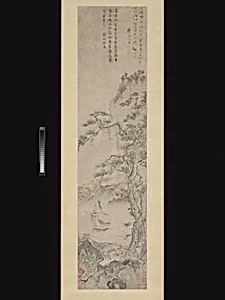
明 杜堇 陶淵明賞菊圖 軸|Tao Yuanming enjoying chrysanthemums
late 15th or early 16th century
Medium
Hanging scrolls; ink and color on paper
Dimensions
Image: 58 1/4 x 14 3/16 in. (148 x 36 cm) Overall with mounting: 105 1/4 x 21 3/16 in. (267.3 x 53.8 cm) Overall with knobs: 105 1/4 x 24 1/2 in. (267.3 x 62.2 cm)
Classification
Paintings
Culture & Period
China · Ming dynasty (1368–1644)
Department
Asian Art
Museum
Metropolitan Museum of Art, New York, NY
Credit
The C. C. Wang Family Collection, Gift of C. C. Wang, 2001
Accession Number
2001.746.2
Rights
Public Domain
Tags
About this artwork
This hanging scroll portrays the celebrated poet-recluse Tao Yuanming (365-427) strolling through mountainous terrain to admire autumn chrysanthemums, accompanied by a servant bearing flowers. Created in the late fifteenth or early sixteenth century, the painting combines meticulous rendering of the human figures with a dashing ink-wash treatment of the landscape, demonstrating Du Jin's mastery of contrasting techniques within a single composition. An inscription poem on the painting reads: "Alo...
Art Historical Context
This exquisite hanging scroll, *Tao Yuanming Enjoy Chrysanthemums*, painted by Du Jin in the late 15th or early 16th century during China's Ming dynasty, captures the poet-recluse Taoming (365–427) wandering through misty mountains to admire vibrant autumn chrysanthemums, by a servant carrying blooms. Rendered in ink and color paper—a traditional format for literati art that allowed for intimate, vertical viewing—this work measures nearly five feet tall when mounted, inviting viewers to unroll and immerse themselves in its serene world. Du Jin, a scholar-poet who turned to professional painting after failing the civil service exams, masterfully blends precise, detailed figures with bold, expressive ink-wash landscapes reminiscent of the Southern Song academic style. An inscribed poem evokes Tao's leisurely return home amid yellow flowers, underscoring themes of withdrawal from political turmoil. This contrast of techniques highlights Du's skill and his liminal status between elite amateur and working artist, much like his friend Tang Yin. Tao Yuanming embodied the ideal of principled retreat from corrupt officialdom, living simply in rural harmony. Chrysanthemums, blooming resiliently in fall, symbolize integrity and became a cherished motif in Chinese literati painting, making this scroll a poignant celebration of enduring cultural values.
About the Artist
Du Jin · 1435–1535
Chinese, active ca. 1465–1509