
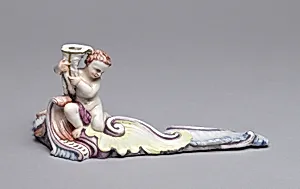
Taperstick (One of Four)
ca. 1750–1760
Classification
ceramics
Department
Smithsonian Collection
Museum
Smithsonian American Art Museum
Credit
Museum purchase from Charles E. Sampson Memorial and General Acqusition Endowment Funds
Accession Number
1987-50-1-b
Rights
Public Domain
About this artwork
Research in Progress
Art Historical Context
Nestled in the Smithsonian American Art Museum's ceramics collection, this *Taperstick (One of Four)* hails from the renowned Doccia Porcelain Factory in Tuscany, Italy, established in 1735 by Marchese Carlo Ginori. Dating to around 1750–1760, it exemplifies the factory's early mastery of porcelain production, a luxurious material that rivaled Europe's finest makers like Meissen and Sèvres. As one of a matching set, this delicate candle holder—designed to support slender tapers for intimate lighting—blends functionality with 18th-century elegance. Doccia's output during this Rococo era featured soft-paste porcelain renowned for its creamy white body, intricate modeling, and often vibrant polychrome enamels or gilding, though specifics on this piece await further research. The factory's innovative techniques, including precise mold-making and firing processes, allowed for ornate sculptural forms that captured the playful asymmetry and natural motifs of Rococo style, symbolizing wealth and refined taste among European elites. Acquired through museum purchase funds, this taperstick highlights the global exchange of decorative arts, bridging Italian craftsmanship with American collections. It invites us to appreciate how such everyday luxuries illuminated grand homes, preserving a snapshot of Enlightenment-era opulence.