
Tapestry Bag
Unknown Artist
7th century
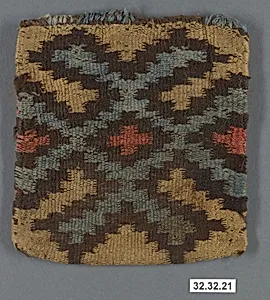
Medium
Camelid hair
Dimensions
Overall: 4 1/2 x 4 3/4 in. (11.43 x 12.07 cm) Other: 4 1/2 in. (11.43 cm)
Classification
Textiles-Woven
Culture
Nasca
Department
Arts of Africa, Oceania, and the Americas
Museum
Metropolitan Museum of Art, New York, NY
Credit
Gift of George D. Pratt, 1932
Accession Number
32.32.21
Rights
Public Domain
Art Historical Context
This exquisite Tapestry Bag, crafted by an unknown Nasca artist in the 7th century, hails from the ancient Nasca culture of southern Peru coastal region. Flourishing from around 100 BCE to 800 CE, the Nasca are renowned for their monumental geoglyphs—the Nazca Lines—and masterful ceramics, but their textiles reveal equally sophisticated artistry. Dating to the culture's late phase, this pouch (just 4½ x 4¾ inches) exemplifies the Nasca enduring legacy in woven works, now housed in the Metropolitan Museum of Art's Department of Arts of Africa, Oceania, and the Americas. Woven from camelid hair—likely vicuña or alpaca, prized for its fine texture and dyeability—the bag employs the labor-intensive tapestry weave technique. In this method, colored wefts are interlocked to create vibrant, pictorial designs without slits, allowing for intricate patterns that might depict mythical motifs or daily life scenes, hallmarks of Nasca textile innovation. Such precision reflects advanced pre-Columbian engineering, where fibers were spun, dyed with natural pigments, and woven on backstrap looms. Culturally, these bags served practical yet prestigious purposes, often carrying coca leaves for rituals or small valuables, symbolizing status and skill. Gifted to the Met in 1932 by George D. Pratt, this artifact invites us to marvel at the Nasca's woven world—a testament to their ingenuity before the rise of later Andean empires.