
Tapestry-Woven Fragment
Unknown Artist
8th century
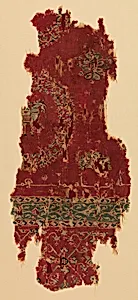
Medium
Wool; slit-tapestry weave with eccentric wefts
Dimensions
Textile: H. 23 1/4 in. (59.1 cm) W. 9 3/4 in. (24.8 cm) Mount: H. 26 3/4 in. (60.3 cm) W. 13 3/8 in. (34 cm) D. 1 3/8 in. (3.5 cm)
Classification
Textiles
Department
Islamic Art
Museum
Metropolitan Museum of Art, New York, NY
Credit
Purchase, Mariana Herrmann Fund, The Page and Otto Marx Jr. Foundation and Rogers Fund, 2001
Accession Number
2001.420
Rights
Public Domain
Art Historical Context
This exquisite *Tapestry-Woven Fragment from the 8th offers a rare glimpse into the sophisticated textile arts of the early Islamic world. Crafted wool in the Islamic Art department of the Metropolitan Museum of, this narrow strip measures about 23 inches high and 9¾ inches wide, likely a surviving piece from a larger garment, hanging, or ceremonial object. Acquired in 2001 through generous funds including the Mariana Herrmann Fund, it exemplifies the technical mastery of anonymous artisans during a golden age of Islamic craftsmanship, when textiles rivaled metalwork and ceramics in prestige. The fragment's slit-tapestry weave technique is particularly noteworthy. In this method, colored wefts are woven back and forth within their own color areas, creating crisp boundaries without discontinuous warps—allowing for vibrant, interlocking patterns that might depict geometric motifs or floral designs common in Islamic art. The use of eccentric wefts, which deviate from straight horizontal paths, adds dynamic texture and complexity, showcasing innovative approaches to color blending and pattern formation without modern dyes or machinery. For museum visitors, this fragment highlights the cultural importance of textiles in Islamic societies, where they symbolized wealth, piety, and artistic ingenuity. Preserved for over a millennium, it invites us to appreciate the enduring legacy of these skilled weavers, whose work adorned palaces and mosques across the expanding Islamic realms.