
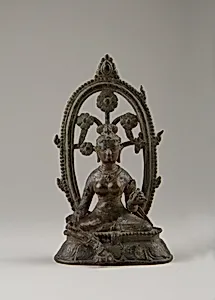
Tara, the Buddhist Savioress
Unknown Artist
ca. second half of the 8th century
Medium
Bronze
Dimensions
H. 6 11/16 in. (17 cm); W. 4 7/8 in. (12.4 cm); D. 2 3/4 in. (7 cm)
Classification
Sculpture
Culture & Period
Bangladesh (probably Comilla District) · Pala period
Department
Asian Art
Museum
Metropolitan Museum of Art, New York, NY
Credit
Gift of John and Evelyn Kossak, The Kronos Collections, 1979
Accession Number
1979.510.3
Rights
Public Domain
Tags
Art Historical Context
This delicate bronze sculpture of *Tara, the Buddhist Savioress*, hails from the Pala period in what is now Bangladesh, likely the Comilla District, dating to the second half of the 8th century. Standing just 6 11/16 inches tall, it captures Tara—one of Buddhism's most beloved female deities—as a compassionate protector who ferries devotees across the sea of suffering toward enlightenment. Her serene posture, with one foot elegantly extended as if stepping forward to aid the faithful, embodies the bodhisattva ideal of selfless rescue, a central theme in Mahayana Buddhism thriving in this region. Crafted in bronze, a medium prized for its durability and ability to convey luminous skin tones through careful alloying and chasing techniques, this Pala-era work reflects the era's artistic peak. The Pala dynasty (8th–12th centuries) patronized Buddhist monasteries, fostering exquisite metalwork that blended Indian, Southeast Asian, and local styles. Though the artist remains unknown, the sculpture's refined proportions and intricate detailing—evident in Tara's jewelry and flowing garments—highlight the sophisticated lost-wax casting methods used in Comilla's workshops. On view in the Metropolitan Museum of Art's Asian Art department, this gift from John and Evelyn Kossak's Kronos Collections invites visitors to ponder Tara's enduring role as a symbol of mercy amid ancient Bengal's spiritual renaissance. A timeless reminder of art's power to inspire hope.