
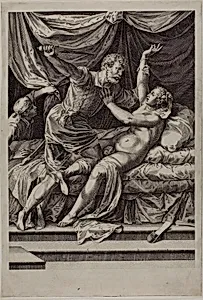
Tarquin and Lucretia
c. 1571
Medium
Engraving in black on ivory laid paper
Dimensions
Plate: 42 × 28.8 cm (16 9/16 × 11 3/8 in.); Sheet: 42.4 × 29.1 cm (16 3/4 × 11 1/2 in.)
Classification
engraving
Department
Prints and Drawings
Museum
Art Institute of Chicago
Accession Number
154012
Rights
Public Domain
About this artwork
The fateful struggle between the lust-crazed Roman prince Tarquin and Lucretia, the chaste wife of another Italian ruler, inspired two engravings by Cornelis Cort after Titian’s well-known painting of this subject (Fitzwilliam Museum, Cambridge, England). This engraving is oriented in the same direction as the painting, though with a more complete composition than the subsequently cropped original work. This impression is a fine, dark and early first state, before the artist’s signature and a po...
Art Historical Context
Behold *Tarquin and Lucret*, a striking engraving by the renowned Dutch printmaker Cornelis Cort, around 1571. This work captures a dramatic moment from ancient Roman legend, as recounted by Livy: the tyrannical prince Sextus Tarquinius assaults the virtuous Lucretia, an event that sparked the revolt against the monarchy and the birth of the Roman Republic. Cort, a master engraver active in Antwerp and Italy, often reproduced compositions by leading painters like Maarten van Heemskerck, bringing classical tales to a wider audience during the Renaissance. Executed in black ink on ivory laid paper, the engraving measures an impressive 42 × 28.8 cm on the plate. Engraving, an intaglio technique where lines are incised into a metal plate and inked under pressure, allowed for exquisite detail and tonal subtlety—hallmarks of Cort's precise, Mannerist style. This medium was revolutionary in the 16th century, enabling affordable dissemination of high-art imagery across Europe, from noble collections to scholarly circles. Housed in the Art Institute of Chicago's Prints and Drawings Department, this piece exemplifies the cultural fascination with moral drama and antiquity in Northern European art. Its intricate lines evoke tension and pathos, inviting visitors to ponder timeless themes of power, violation, and retribution. A testament to printmaking's golden age!
About the Artist
Cornelis Cort · 1533–1578
Comment on works: copper engraver; engraver; etcher