
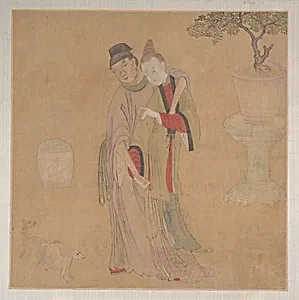
清 佚名 傳勾龍爽 番酋四歡八樂圖 冊頁|Tartar Officer with Blonde Lady
19th century
Medium
Eight album leaves; color on silk
Dimensions
(a): 10 1/2 x 10 1/2 in. (26.7 x 26.7 cm) (b): 10 1/2 x 11 1/8 in. (26.7 x 28.3 cm) (c): 10 1/2 x 11 1/8 in. (26.7 x 28.3 cm) (d): 10 1/2 x 11 in. (26.7 x 27.9 cm) (e) 10 1/2 x 11 in. (26.7 x 27.9 cm) (f) 10 1/2 x 11 in. (26.7 x 27.9 cm) (g) 10 1/2 x 11 in. (26.7 x 27.9 cm) (h) 10 1/2 x 11 in. (26.7 x 27.9 cm)
Classification
Paintings
Culture & Period
China · Yuan (1271–1368)–Qing dynasty (?) (1644–1911)
Department
Asian Art
Museum
Metropolitan Museum of Art, New York, NY
Credit
Gift of A. W. Bahr, 1947
Accession Number
47.135.2a–h
Rights
Public Domain
Tags
Art Historical Context
This exquisite set of eight album leaves titled *Tartar Officer with Blonde* (or in Chinese, *Fan Shu Si Huan Ba Le*), dates to the 19th century during China's Qing dynasty. Created by an unidentified artist, possibly attributed to Gou Longsh, the work is rendered in vibrant colors on silk—a luxurious medium favored in Chinese painting for its smooth surface that allows delicate brushwork and luminous hues. Each leaf measures around 10½ x 11 inches, forming an intimate album format ideal for private contemplation or scholarly exchange. The pages depict lively scenes of "Tartar" (likely referring to Manchu or Mongol chieftains) officers engaged in "four joys and eight pleasures," featuring men, women, and dogs in convivial, possibly erotic pursuits. A standout image shows a Tartar officer with a blonde lady, evoking exotic encounters amid Qing-era global trade and cultural exchanges, such as those during the Opium Wars. These motifs blend traditional Chinese figure painting with intriguing foreign elements, highlighting the dynasty's fascination with the "barbarian other." Housed in the Metropolitan Museum of Art's Asian Art department (gift of A. W. Bahr, 1947), this album offers a window into 19th-century elite tastes, where silk's fragility preserved candid glimpses of leisure and cross-cultural curiosity. A true gem for exploring Qing artistic whimsy!