
Tazza
Unknown Artist
19th century, early 17th century original
Medium
Silver on base metal
Dimensions
Overall: 7 1/2 × 13 1/2 in. (19.1 × 34.3 cm)
Classification
Metalwork-Electrotype
Culture
British, after Portuguese original
Department
European Sculpture and Decorative Arts
Museum
Metropolitan Museum of Art, New York, NY
Credit
Gift of Henry G. Marquand, 1883
Accession Number
83.18.112
Rights
Public Domain
Art Historical Context
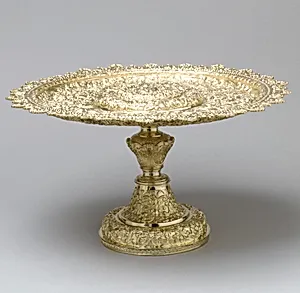
Behold the elegant *Tazza*, a shallow ornamental bowl elevated on a foot, evoking the grandeur of early 17th-century Portuguese craftsmanship. This British electrotype reproduction, crafted in the 19th, faithfully captures the intricate details of its Iberian original, showcasing the opulent metalwork traditions of Renaissance-era Europe. Standing at 7½ × 13½ inches, it exemplifies the tazza's role as a ceremonial vessel for wine or banquets among nobility, blending functionality with lavish decoration. The medium—silver electroplated over base metal—highlights a revolutionary 19th-century technique that democratized access to historical treasures. Electrotyping involved depositing a thin layer of silver via electrolysis onto a mold, producing precise, affordable copies for museums and collectors. This innovation preserved the tactile splendor of rare Portuguese silver without risking originals, underscoring Britain's era of industrial ingenuity and cultural revival. Generously gifted to the Metropolitan Museum of Art in 1883 by Henry G. Marquand, this piece resides in the European Sculpture and Decorative Arts department. It invites visitors to ponder the bridges between eras: from Portugal's seafaring golden age to Victorian fascination with the past. A testament to enduring artistry, it reminds us how reproductions can spark wonder and scholarship alike.