
Tea Caddy
1762–63
Medium
Silver
Dimensions
Overall: 4 7/8 x 3 15/16 x 3 1/16 in. (12.4 x 10 x 7.8 cm); 8 oz. 17 dwt. (274.5 g) Body: H. 4 1/8 in. (10.5 cm); 7 oz. 1 dwt. (219.9 g) Cover: 1 oz. 15 dwt. (54.6 g)
Classification
Tea Caddy
Culture
British
Department
The American Wing
Museum
Metropolitan Museum of Art, New York, NY
Credit
Gift of William S. Verplanck, 1959
Accession Number
59.30a, b
Rights
Public Domain
Art Historical Context
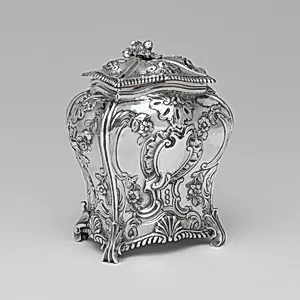
In the opulent world of 18th-century Britain, tea drinking emerged as a cherished social ritual among the elite, transforming the simple beverage into a symbol of refinement and hospitality. This exquisite silver tea caddy, crafted by London silversmith Emick Romer between 1762 and 1763, exemplifies that era's luxury craftsmanship. Measuring a compact 4⅞ x 3¾ x 3 inches and weighing about 8½ ounces, it was designed to securely store precious tea leaves—imported at great expense from China—in a divided interior, often with a lock to deter servants. Romer's work reflects the Georgian period's rococo influences, with its elegant proportions and finely chased silver surfaces that would have gleamed in a fashionable drawing room. Housed in The American Wing of The Metropolitan Museum of Art, thanks to a 1959 gift from collector William S. Verplanck, this British artifact bridges transatlantic tastes. Colonial American elites emulated British manners, making such caddies coveted status symbols in households from New York to Philadelphia. Romer's hallmark attests to his skill as a specialist in domestic silver, where techniques like hammering, soldering, and engraving ensured both functionality and artistry. Today, it invites us to savor a slice of everyday elegance from a time when tea time was high art.