
Medium
ceramics
Classification
ceramics
Department
Smithsonian Collection
Museum
Smithsonian American Art Museum
Credit
Gift of Eleanor Garnier Hewitt
Accession Number
1931-40-40-a,b
Rights
Public Domain
About this artwork
Research in Progress
Art Historical Context
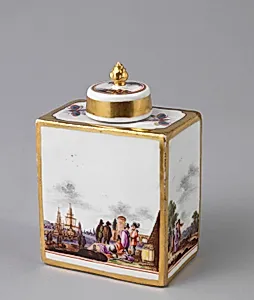
This elegant tea caddy, crafted by the renowned Meissen Porcelain Manactory around 1740, exemplifies the pinnacle of European porcelain production. Founded in 1710 in Dresden, Germany, Meissen the first manufactory on the continent to successfully produce true hard-paste porcelain—a durable, translucent material long monopolized by Chinese artisans. By the 1740s, under the influence of modeler Johann Joachim Kändler, Me pieces like this one embraced the ornate Rococo style, featuring delicate modeling, gilded accents, and vibrant overglaze enameling that mimicked Oriental luxury wares. Tea caddies were essential household luxuries in 18th-century Europe, as tea—a newly fashionable import from Asia—symbolized refinement and social status among the elite and emerging middle class. Securely locking to protect precious leaves from theft or spoilage, these diminutive containers blended functionality with artistry, often shaped as domed boxes or faux pagodas. Meissen's technical mastery in firing porcelain at high temperatures allowed for intricate details impossible in softer ceramics, revolutionizing tableware and decorative arts. Today, housed in the Smithsonian American Art Museum as a gift from Eleanor Garnier Hewitt, this tea caddy invites us to savor the era's blend of innovation and opulence, a testament to Germany's artistic ambition amid global trade. (198 words)