
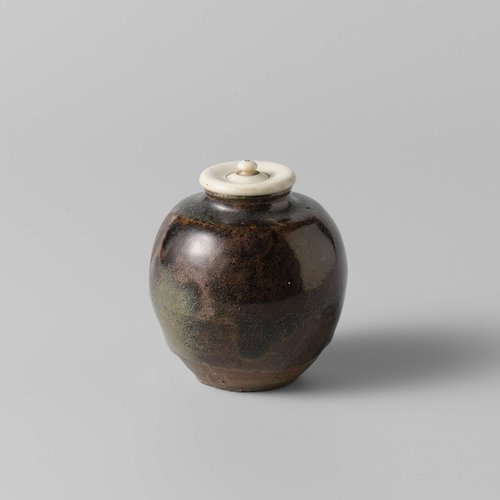
Tea caddy with a green brown glaze
ca. 1800 - ca. 1899
Medium
turning
Dimensions
1.2; 2.9; 3.1; 3.2; 6.5; 7.2; 6.6
Rights
Public Domain
About this artwork
…; collection of Herman Karel Westendorp (1868-1941), Amsterdam, 1941;{Note RMA.} his widow Betsy Westendorp-Osieck (1880-1968), Amsterdam, by whom bequeathed to the Vereniging van Vrienden der Aziatische Kunst, 1968;{note RMA.} from whom on loan to the museum, 1972
Art Historical Context
This elegant tea caddy, standing just 7.2 centimeters tall, dates from the nineteenth century and was crafted using the ancient technique of turning, or wheel-throwing. The anonymous maker applied a subtle green-brown glaze that enhances the vessel’s modest form, creating a harmonious surface suited to daily use. Such small containers were essential for preserving the freshness of tea leaves, reflecting the importance of tea in social and domestic rituals across Asia during this period. Although the artist remains unknown, the caddy’s refined simplicity speaks to a long tradition of functional yet aesthetically pleasing ceramics. The turning process allowed for precise shaping, while the glaze not only protected the contents but also added visual warmth. These qualities made such objects both practical household items and quiet expressions of craftsmanship. The piece entered the collection of Dutch Asian art enthusiast Herman Karel Westendorp in the early twentieth century and later passed through his widow to the Vereniging van Vrienden der Aziatische Kunst. Since 1972 it has been on loan to the museum, where it continues to illustrate the enduring appeal of everyday objects elevated by careful making.