
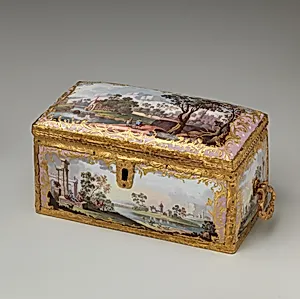
Tea casket (part of a set)
Unknown Artist
ca. 1770
Medium
White enamel on copper painted in polychrome enamels
Dimensions
Overall (confirmed): 4 1/2 × 9 1/2 × 4 3/8 in. (11.4 × 24.1 × 11.1 cm)
Classification
Enamels-Painted
Culture
British, South Staffordshire
Department
European Sculpture and Decorative Arts
Museum
Metropolitan Museum of Art, New York, NY
Credit
Gift of Irwin Untermyer, 1964
Accession Number
64.101.834
Rights
Public Domain
Tags
Art Historical Context
This elegant tea casket, crafted around 1770 in South Staffordshire, England, exemplifies the height of British enameling artistry during the Georgian era. Produced in a region renowned for its skilled workshops—particularly in Bilston and Wednesbury—these luxurious containers were designed to store precious tea leaves, a status symbol for affluent households. As part of a matching set, it reflects the era's fascination with domestic refinement and the growing popularity of tea culture among the British elite. The casket's medium—white enamel on copper, painted in vibrant polychrome enamels—showcases a meticulous technique where finely ground glass pigments were applied in multiple layers and fired at high temperatures to create durable, jewel-like colors. Delicate landscape scenes, a favored motif in Staffordshire enamels, adorn its surfaces, evoking pastoral idylls that transported viewers to imagined rural retreats amid urbanizing Britain. Measuring a compact 4½ × 9½ × 4⅜ inches, its intricate detailing highlights the enamellers' virtuosity in miniaturization. Housed in The Metropolitan Museum of Art's European Sculpture and Decorative Arts Department since a 1964 gift from Irwin Untermyer, this piece offers a glimpse into 18th-century craftsmanship, blending functionality with ornamental splendor.