
Tea Table
1765–75
Medium
Mahogany, mahogany veneer, maple
Dimensions
27 1/8 x 35 x 23 in. (68.9 x 88.9 x 58.4 cm)
Classification
Tea table
Culture
American
Department
The American Wing
Museum
Metropolitan Museum of Art, New York, NY
Credit
Purchase, Emily Crane Chadbourne Gift, 1961
Accession Number
61.42
Rights
Public Domain
Art Historical Context
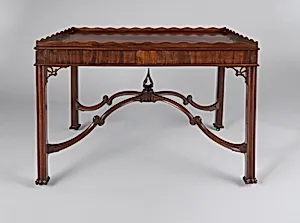
Nestled in The American Wing of the Metropolitan Museum of Art, Robert Harrold's *Tea Table* (1765–75) exemplifies the refined craftsmanship of colonial American furniture. Crafted from mahogany with mahogany veneer and maple, this elegant piece measures 27 1/8 x 35 x 23 inches, perfect for intimate social gatherings. Harrold, a skilled cabinetmaker, created it during a prosperous era in pre-Revolutionary America, when imported hardwoods like mahogany symbolized status and sophistication. Mahogany, sourced from the West Indies, was a luxury material prized for its rich reddish-brown hue, durability, and ability to take a high polish. The use of veneer—a thin layer of fine mahogany applied over a base—allowed artisans like Harrold to showcase intricate grain patterns and decorative effects economically, blending functionality with artistry. Maple likely provided contrast in secondary elements, highlighting the table's balanced proportions. This tea table reflects the cultural ritual of tea-drinking among the colonial elite, a leisurely pastime imported from Britain that fostered conversation and display. Acquired through the Emily Crane Chadbourne Gift in 1961, it invites visitors to envision 18th-century parlors alive with the clink of porcelain and the aroma of freshly brewed leaves, bridging us to America's elegant past.