
Tea tray (Plateau)
Medium
Faience (tin-glazed earthenware)
Dimensions
25 x 19 1/8 in. (63.5 x 48.6 cm)
Classification
Ceramics-Pottery
Culture
French, Rouen
Department
European Sculpture and Decorative Arts
Museum
Metropolitan Museum of Art, New York, NY
Credit
Gift of J. Pierpont Morgan, 1917
Accession Number
17.190.1835
Rights
Public Domain
Tags
Art Historical Context
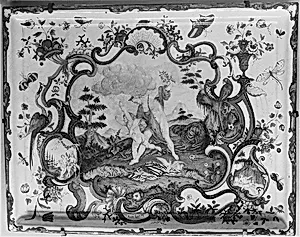
This exquisite tea tray, or *plateau*, hails from Rouen, France, around 1750–60, a golden era for faience production in the region. Crafted from tin-glazed earthenware, medium prized for its vibrant colors and glossy sheen achieved through a tin-oxide glaze fired over earthenware, it exemplifies the technical mastery of Rouen's workshops. At 25 x 19⅛ inches, it's generously sized for serving tea—a fashionable ritual among 18th-century European elites—blending functionality with opulent decoration. Attributed to collaborators including The Muses Master, François Bernard l'Epicier, Jean Marc Nattier, and Pierre Chapelle II, it reflects the collaborative spirit of French ceramic ateliers. The tray's surface bursts with Rococo charm, featuring playful motifs of Venus and Cupid amid birds and insects, evoking mythological whimsy and the natural world's delight. These elements capture the era's taste for elegant, lighthearted luxury, where classical gods frolic in pastoral scenes. Rouen faience, rivaling porcelain imports, symbolized France's artisanal prowess and cultural sophistication. A gift to the Metropolitan Museum of Art from J. Pierpont Morgan in 1917, this piece invites visitors to savor the intersection of daily ritual and artistic fantasy in Enlightenment-era France.
About the Artist
The Muses Master|François Bernard l'Epicier|Jean Marc Nattier|Pierre Chapelle II ( |French|French| ) · 1700 |1698 |1685 |1684 –1800 |1755 |1766 |1760
|French, Paris 1698–1755 Paris|French, Paris 1685–1766 Paris|1684–1760