
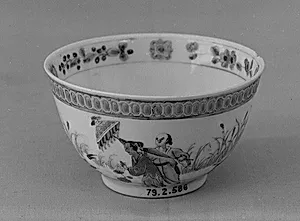
Teabowl
ca. 1736–38
Medium
Hard-paste porcelain
Dimensions
Overall: 1 1/2 × 2 7/8 in. (3.8 × 7.3 cm)
Classification
Ceramics-Porcelain-Export
Culture
Chinese, for Dutch market
Department
European Sculpture and Decorative Arts
Museum
Metropolitan Museum of Art, New York, NY
Credit
Purchase by subscription, 1879
Accession Number
79.2.586
Rights
Public Domain
Tags
Art Historical Context
This delicate teabowl crafted in hard-paste porcelain around 1736–38, exemplifies the vibrant trade networks that connected China and Europe in the eighteenth century. Created in China specifically for the Dutch market, it was designed by Cornelis Pronk, a Dutch artist commissioned by the Dutch East India Company to supply patterns that blended European tastes with Chinese ceramic expertise. At just over an inch tall, the small vessel highlights how such export wares were both functional drinking vessels and objects of refined display in European homes. Pronk’s designs often featured carefully observed figures, and the presence of male subjects here reflects the period’s fascination with exotic yet relatable imagery. The use of true hard-paste porcelain—fired at extremely high temperatures for its characteristic strength and translucency—underscored China’s technical superiority at a time when European factories were still struggling to replicate the material. Acquired by the Metropolitan Museum in 1879, this teabowl remains a quiet witness to the global exchange of art, commerce, and culture.
About the Artist
Cornelis Pronk · 1691–1759
Comment on works: Portraits; Views; Landscapes; Interiors