
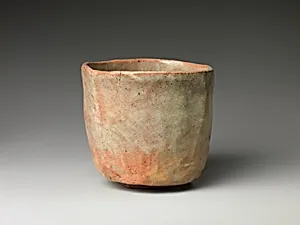
Teabowl
ca. 1710
Medium
Clay covered with glaze (Raku ware)
Dimensions
H. 4 in. (10.2 cm); Diam. 4 1/8 in. (10.5 cm)
Classification
Ceramics
Culture & Period
Japan · Edo period (1615–1868)
Department
Asian Art
Museum
Metropolitan Museum of Art, New York, NY
Credit
Rogers Fund, 1917
Accession Number
17.118.73
Rights
Public Domain
Art Historical Context
This exquisite teabowl, crafted the renowned Raku potter Sonyu 1710 during Japan's Edo period (16151868), exemplifies the intimate artistry of Raku ware. Standing just 4 inches high and4⅛ inches in diameter, modest scale belies its profound cultural role in the Japanese tea ceremony, or *chanoyu*. Produced in Kyoto, Raku ceramics were hand-built from clay and fired at low temperatures, then often removed from the kiln while glowing hot and cooled rapidly to create unique, crackled glazes and smoky effects. Raku ware's significance lies in its embodiment of *wabi-sabi*—the tea master's aesthetic celebrating imperfection, transience, and natural simplicity. Sonyu, part of the esteemed Raku lineage, mastered techniques like feather-applied glazes and post-firing reduction, yielding matte, earthy surfaces that invite tactile appreciation. Far from mass-produced porcelain, these bowls were treasured by samurai and merchants alike for their rustic beauty and ritual functionality. Acquired through the Rogers Fund in 1917, this teabowl now graces the Metropolitan Museum of Art's Asian Art collection, offering visitors a tangible link to Edo-era refinement. Hold it in your mind's eye: the subtle weight, the glaze's whisper-soft sheen—pure poetry in clay.