
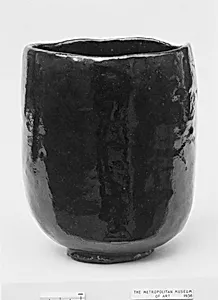
Teabowl
18th century
Medium
Clay, thick black glaze, patch of reddish underglaze (Raku ware)
Dimensions
H. 5 1/4 in. (13.3 cm); Diam. 4 1/4 in. (10.8 cm)
Classification
Ceramics
Culture & Period
Japan · Edo period (1615–1868)
Department
Asian Art
Museum
Metropolitan Museum of Art, New York, NY
Credit
The Howard Mansfield Collection, Gift of Howard Mansfield, 1936
Accession Number
36.120.534
Rights
Public Domain
Art Historical Context
This elegant teabowl by the Japanese artist Sonyu was made in the 18th century during the Edo period. Fashioned as Raku ware from clay with a thick black glaze and a striking reddish underglaze patch, the vessel stands 5¼ inches high with a 4¼-inch diameter—compact proportions perfectly suited to the intimate scale of the Japanese tea ceremony. Raku ceramics, developed in Kyoto, are distinguished by their hand-built forms and low-temperature firing, which produce rich, unpredictable glaze effects. In the Edo period, when tea culture flourished among samurai and merchants alike, such bowls were prized for their tactile warmth and subtle irregularities that invited quiet appreciation during chanoyu. Now part of the Metropolitan Museum of Art’s Asian Art collection through the 1936 gift of Howard Mansfield, this teabowl continues to connect viewers with centuries of Japanese ceramic tradition.