
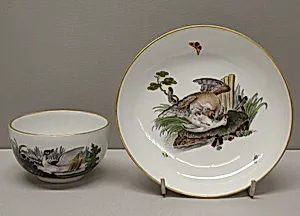
Teacup and saucer
ca. 1775
Medium
Hard-paste porcelain
Dimensions
Diameter, saucer: 5 1/16 in. (12.9 cm) Overall, cup: 1 5/8 x 3 3/4 in. (4.1 x 9.5 cm)
Classification
Ceramics-Porcelain
Culture
German, Höchst
Department
European Sculpture and Decorative Arts
Museum
Metropolitan Museum of Art, New York, NY
Credit
Gift of Mercedes Bass, 2007
Accession Number
2007.243.18a, b
Rights
Public Domain
Tags
Art Historical Context
Step into the elegant world of 18th-century European porcelain with this delicate teacup and sa from the Höchst Manactory, crafted around 1775. Produced in the German town of Höchst near Frankfurt, this hard-paste porcelain piece exemplifies rococo style's love for whimsy and refinement. Measuring a dainty 5 1/16 inches in saucer diameter and 15/8 x 3 3/4 inches for the cup, it was designed for intimate tea rituals, a fashionable social pastime among Europe's aristocracy. Höchst, founded in 1746, was a key player in Europe's porcelain race to rival China's coveted imports. Hard-paste porcelain—fired at high temperatures for exceptional durability and translucency—marked a technical triumph, allowing intricate modeling and vibrant painting. Adorned with motifs of birds and butterflies, likely hand-painted or appliquéd, the decoration captures rococo's delight in nature's playful asymmetry, evoking gardens alive with fluttering life. Today, this gift to the Metropolitan Museum of Art from Mercedes Bass in 2007 highlights the cultural prestige of such wares. Teacups like this weren't just functional; they symbolized sophistication and the era's obsession with luxury goods, bridging art and daily indulgence in Enlightenment-era Germany.