
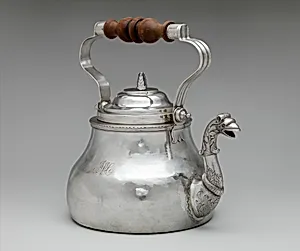
Teakettle
1710–20
Medium
Silver
Dimensions
Overall: 10 1/8 x 10 5/8 in. (25.7 x 27 cm); 47 oz. 13 dwt. (1481.7 g) Base: Diam. 7 3/8 in. (18.7 cm) Body: H. 7 7/16 in. (18.9 cm)
Classification
Teakettle
Culture
American
Department
The American Wing
Museum
Metropolitan Museum of Art, New York, NY
Credit
Bequest of James Stevenson Van Cortlandt, 1917
Accession Number
40.145a, b
Rights
Public Domain
Art Historical Context
Crafted by New York silversmith Cornelius Kierst around 1710–20, this elegant teakettle exemplifies early silverwork during the colonial era. Standing at 10 1/8 10 5/8 inches and weighing a substantial 47 ounces, it reflects the craftsmanship of a master artisan whose family had deep roots in the city's Anglo-Dutch silversmithing tradition. Kierstede pieces, often marked with his distinctive touchmark, blended European influences like the restrained Queen Anne style—characterized by graceful curves and balanced proportions—with practical functionality for the emerging colonial elite. Silver teakettles like this one were symbols of wealth and hospitality in 18th-century America, as tea drinking gained popularity among the upper classes. The kettle's pear-shaped body, flared base (7 3/8 inches in diameter), and ergonomic handle and spout made it ideal for serving, while its high-quality silver ensured durability and shine. Housed in The Metropolitan Museum of Art's American Wing, it entered the collection through the 1917 bequest of James Stevenson Van Cortlandt, linking it to one of New York's prominent families. This teakettle offers a tangible glimpse into everyday luxury of the time, showcasing how immigrant artisans like Kierstede helped forge a distinctly American aesthetic in decorative arts. Visitors can appreciate its polished surfaces, which still gleam after three centuries, evoking the refined social rituals of colonial life.