
Teapot
ca. 1842–51
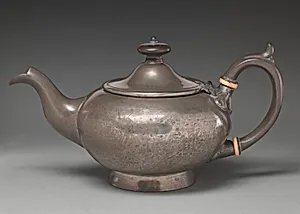
Medium
Britannia metal; bone
Dimensions
Overall: 5 × 9 7/8 × 5 1/2 in. (12.7 × 25.1 × 14 cm)
Classification
Metalwork-Base Metal
Culture
British, Sheffield
Department
European Sculpture and Decorative Arts
Museum
Metropolitan Museum of Art, New York, NY
Credit
Bequest of Delight L. Sherwin, 1990
Accession Number
1990.92.2
Rights
Public Domain
Art Historical Context
This elegant teapot, crafted by renowned Sheffield firm James Dixon & Sons around1842–51, exemplifies the pinnacle of British base metal craftsmanship during the Victorian era. Made from Britannia metal—a durable, silvery alloy resembling pewter—with bone accents for the handle and finial, it measures a compact 5 × 9 7/8 × 5 1/2 inches. Sheffield, the heart of Britain's metalworking industry, was famed for producing affordable yet refined tablewares through innovative casting and spinning techniques, making luxury accessible to the growing middle class. The teapot's neoclassical-inspired design, with its pear-shaped body, flared spout, and chased decoration, reflects the era's blend of functionality and ornamentation. Tea drinking had become a cherished British ritual by the mid-19th century, symbolizing domestic comfort and social status; such pieces were staples in genteel households. James Dixon & Sons, established pioneers in electroplating and pewter, elevated everyday objects into artful heirlooms. Now part of the Metropolitan Museum of Art's European Sculpture and Decorative Arts collection—thanks to the bequest of Delight L. Sherwin in 1990—this teapot invites us to savor the industrial ingenuity that fueled Britain's decorative arts legacy.