
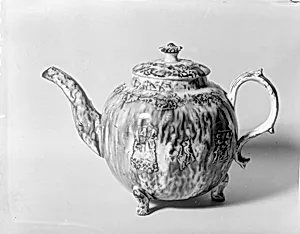
Teapot
Medium
Earthenware
Dimensions
H. 5 3/4 in. (14.6 cm)
Classification
Teapot
Culture
British (American market)
Department
The American Wing
Museum
Metropolitan Museum of Art, New York, NY
Credit
Gift of Josephine Atterbury, 1945
Accession Number
45.13.10a, b
Rights
Public Domain
Art Historical Context
This elegant earthenware teapot, created between 1750 and 1760 by the Wedg-Whieldon partnership, reflects the vibrant collaboration between two pioneering Staffordshire potters. Thomas Whieldon and the young Josiah Wedgwood worked together during this period to experiment with colorful glazes and durable forms, producing affordable yet refined tableware that appealed to a growing middle class. Intended for the American market, the piece highlights the lively transatlantic trade in ceramics during the mid-eighteenth century. As tea drinking became a daily ritual in colonial households, British potters supplied stylish vessels that blended practicality with modest ornament. Standing just 5¾ inches tall, this compact teapot would have been part of a matching service, its simple yet sturdy design suited to everyday use across the ocean. Now housed in the Metropolitan Museum’s American Wing, the teapot offers visitors a tangible connection to shared British and American material culture before the Revolution. Its presence in the collection, gifted by Josephine Atterbury in 1945, underscores how such objects illuminate the tastes and trade networks that shaped early American homes.