
Teapot
c. 1700
Medium
Gilded silver and enameled copper
Dimensions
14.5 × 23.2 × 14.3 cm (5 11/16 × 9 1/8 × 5 5/8 in.)
Classification
teapot
Department
Applied Arts of Europe
Museum
Art Institute of Chicago
Accession Number
151564
Rights
Public Domain
About this artwork
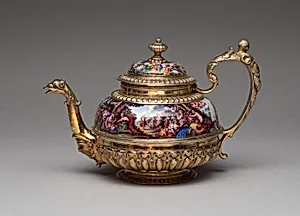
The complex enamel scenes on this tea service represent the four classical elements: air, earth, fire, and water. On one saucer Cybele, an Anatolian mother goddess who ruled over nature, personifies earth, while attendants present her with a bounty of animals, flowers, and fruit. The enamel’s pristine condition suggests that this tea service was rarely used; more likely, it was reserved for display as part of a collector’s cabinet.
Art Historical Context
Crafted around 1700 by Matthäus Baur II, a skilled German silversmith likely from the renowned workshops of Augsburg, this elegant teapot exemplifies the opulence of early 18th-century European decorative arts. Standing at 14.5 × 23.2 × 14.3 cm, its gilded silver body gleams with a warm golden sheen, while intricate enameled copper accents add vibrant color and fine detail. Housed in the Art Institute of Chicago's Department of Applied Arts of Europe, it reflects the height of Baroque craftsmanship, where functionality met lavish ornamentation. At the dawn of the 1700s, tea—a novel luxury imported from Asia—swept through European aristocratic circles, sparking demand for sophisticated silver services. Teapots like this one were status symbols, blending practicality with artistry to elevate everyday rituals. Baur's design captures this cultural shift, its form optimized for pouring while showcasing the silversmith's mastery. The medium's brilliance lies in its techniques: gilding mercury-applied gold onto silver for enduring luster, paired with enameling—fusing powdered glass onto copper for jewel-like hues resistant to wear. These methods, honed in German metalworking centers, highlight the era's fusion of technology and aesthetics, making this teapot not just a vessel, but a miniature masterpiece of cultural refinement.