
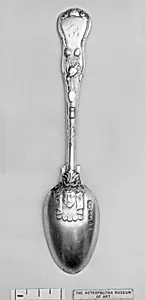
Teaspoon
1836–37
Medium
Silver
Dimensions
Length: 5 3/4 in. (14.6 cm)
Classification
Metalwork-Silver
Culture
British, London
Department
European Sculpture and Decorative Arts
Museum
Metropolitan Museum of Art, New York, NY
Credit
Gift of Mrs. Samuel P. Avery, 1897
Accession Number
97.2.14
Rights
Public Domain
Art Historical Context
This elegant silver teaspoon, crafted in London between 1836 and 1837, offers a charming glimpse into the refined domestic rituals of early Victorian Britain. Marked with the initials “W. K.,” the maker remains unidentified, yet the piece reflects the high standards of London’s silversmithing trade during a period when tea drinking had become a central social custom among the middle and upper classes. Its modest scale—just 5¾ inches long—belies the care invested in even the smallest household objects, which were often fashioned from precious metals to convey both utility and quiet luxury. Silver’s enduring appeal in the 1830s lay in its luminous surface and durability, qualities that allowed artisans to create graceful forms suited to daily use while also serving as subtle markers of status. Teaspoons like this one formed part of larger matched services, their slender handles and shallow bowls designed to complement the era’s increasingly elaborate tea tables. Acquired by the Metropolitan Museum through a generous gift in 1897, the spoon now stands as a tangible reminder of how everyday metalwork captured the taste and craftsmanship of its time.