
Temperance
Medium
Etching
Dimensions
Sheet (trimmed): 2 15/16 × 1 15/16 in. (7.5 × 4.9 cm)
Classification
Prints
Department
Drawings and Prints
Museum
Metropolitan Museum of Art, New York, NY
Credit
The Elisha Whittelsey Collection, The Elisha Whittelsey Fund, 1951
Accession Number
51.501.2277
Rights
Public Domain
Tags
Art Historical Context
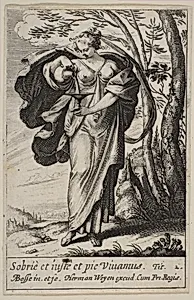
"Temperance," an exquisite etching from 1636 Herman Weyen and Abraham Bosse, captures essence of one of the cardinal virtues in a compact, intimate format. Measuring just under 3 by 2 inches, this trimmed sheet exemplifies the refined printmaking of 17th-century France, where Bosse—a leading etcher of his time—excelled in translating intricate designs into delicate lines. Likely part of a series on moral virtues, the artwork personifies Temperance as a female nude, a common allegorical motif blending classical antiquity with Christian ethics during the Baroque era. Etching, the medium here, allowed artists like Bosse to achieve fluid, expressive lines by biting acid into a metal plate, producing editions that democratized art for a wider audience beyond oil paintings. Bosse's technical innovations, including his detailed shading and textures, made prints like this both collectible treasures and vehicles for moral instruction amid the Counter-Reformation's emphasis on virtue. Housed in the Metropolitan Museum of Art's Drawings and Prints department through The Elisha Whittelsey Collection, "Temperance" invites visitors to ponder restraint and balance—timeless ideals rendered with surprising sensuality in a nude form. Its small scale belies its cultural weight, reflecting how prints shaped everyday piety and aesthetics in Louis XIII's France.
About the Artist
Herman Weyen|Abraham Bosse (Flemish|French) · 1600 |1602 –1672 |1676
Flemish, died Paris, 1672|French, Tours 1602/04–1676 Paris