
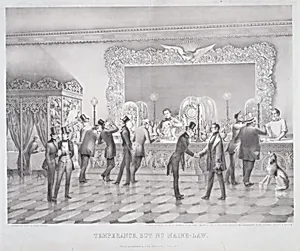
Temperance, but No Maine Law
1854
Medium
Lithograph
Dimensions
image: 19 x 25 3/16 in. (48.3 x 63.9 cm) sheet: 25 1/16 x 30 13/16 in. (63.6 x 78.2 cm)
Classification
Prints
Department
Drawings and Prints
Museum
Metropolitan Museum of Art, New York, NY
Credit
The Edward W. C. Arnold Collection of New York Prints, Maps and Pictures, Bequest of Edward W. C. Arnold, 1954
Accession Number
54.90.1054
Rights
Public Domain
Tags
Art Historical Context
In the mid-19th century, the Temperance movement swept across America advocating for sobriety, Augustus Fay's 1854 lithograph *Temperance, but No Law* offers a cheeky commentary on the era's social tensions. The title slyly references the Maine Law of 1851 nation's first statewide prohibition statute—suggesting a hypocritical or unenforced "temperance" drinking persists. Tags like "Men," "Dogs," and "inking" hint at a lively, satirical scene likely depicting revelers with canine companions, capturing the cultural clash between moral reformers and everyday imbibers. As a lithograph, printed from a stone plate with greasy crayon and water-based ink, this work exemplifies a revolutionary technique that allowed for affordable, mass-produced imagery. Measuring nearly 19 x 25 inches, Fay's print was ideal for broad distribution via newspapers or posters, amplifying its humorous critique. Housed in the Metropolitan Museum of Art's Drawings and Prints department from the Edward W. C. Arnold Collection, it reflects New York City's vibrant print culture, where artists like Fay used wit to navigate heated debates on alcohol and public behavior. This piece invites visitors to ponder how art mirrored—and mocked—America's push for reform, reminding us that history's temperance battles were as much about human nature as legislation.