
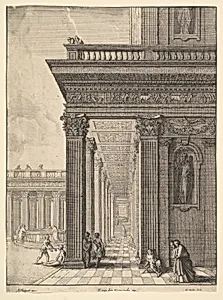
Temple colonnade and courtyard with figures
Medium
Etching; second state of three
Dimensions
Sheet: 8 11/16 × 6 7/16 in. (22 × 16.3 cm)
Classification
Prints
Department
Drawings and Prints
Museum
Metropolitan Museum of Art, New York, NY
Credit
Purchase, Joseph Pulitzer Bequest, 1917
Accession Number
17.50.18-158
Rights
Public Domain
Tags
Art Historical Context
Behold *Temple Colonnade and Courtyard with Figures*, a captivating etching from 1644–52, attributed to a remarkable collaboration among Flemish and German masters: David Teniers the Elder, Frans van den Wyngaerde, Adam Elsheimer, and Wenceslaus Hollar. This second state of three, measuring 8 11/16 × 6 7/16 inches, exemplifies the intricate printmaking techniques of the 17th century, where etching allowed for fine lines and tonal depth to evoke architectural grandeur and human activity. The scene depicts a classical temple colonnade framing a lively courtyard bustling with figures, blending architectural precision with subtle narrative charm. Hollar, renowned for his topographical etchings, likely led the reproductive mastery here, faithfully interpreting designs from his illustrious peers. Teniers the Elder’s genre influences and Elsheimer’s luminous landscapes infuse the composition with a sense of depth and everyday vitality, characteristic of Northern Baroque print culture. Acquired through the Joseph Pulitzer Bequest in 1917, this print at the Metropolitan Museum of Art highlights the era’s fascination with antiquity and perspective, inviting visitors to ponder how such portable artworks bridged courts, collectors, and classical ideals across Europe. A testament to collaborative genius!
About the Artist
David Teniers the Elder|Frans van den Wyngaerde|Adam Elsheimer|Wenceslaus Hollar · 1610–1690
Mostly known for his small-scale cabinet paintings of rustic genre scenes. This artist was alternately known as both The Elder and The Younger (also Junior and Senior) as he was both the father of David Teniers III and the son of David Teniers I. He became a master of the Antwerp Guild of St Luke in 1632–3 after an apprenticeship to his father, with whom he also collaborated. In 1637 he married An...