
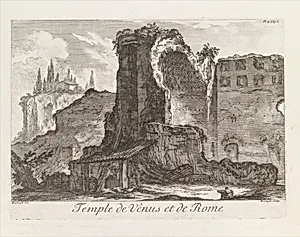
Temple de Venus et de Rome, from Les Plus Beaux Monuments de Rome Ancienne ou Recueil des plus beaux Morceaux de l'Antiquité Romaine qui existent encore
Medium
Etching
Dimensions
Plate: 7 5/8 × 10 1/2 in. (19.4 × 26.7 cm)
Classification
Prints
Department
Drawings and Prints
Museum
Metropolitan Museum of Art, New York, NY
Credit
Rogers Fund, 1952
Accession Number
52.519.87(10)
Rights
Public Domain
Tags
Art Historical Context
In the heart of ancient Rome stood the grand Temple of Venus and Rome one of the city's largest sanctuaries, dedicated to the goddesses Venus Felix (bringer of prosperity) and Roma Aeterna (eternal). Built by Emperor Hadrian in the 2nd AD and later rebuilt after a fire, its ruins by the 18th century captivated Grand Tour travelers and scholars. This 1761 etching, titledTemple de Venus et de*, captures those evocative remains with meticulous detail, part of the lavishly illustrated series *Les Plus Beaux Monuments de Rome Ancienne*, a celebrated collection documenting surviving fragments of Roman antiquity. Created through collaborative efforts by artists and publishers including Jean Barbault, Domenico Montagu, and firms like Bouchard & Gravier, this print exemplifies 18th-century veduta—precise, atmospheric views that fueled the Neoclassical revival. Etching, the medium here, allowed for intricate lines and tonal depth on a modest plate (7 5/8 × 10 1/2 in.), making these treasures accessible to collectors across Europe. Housed in The Metropolitan Museum of Art's Drawings and Prints department (Rogers Fund, 1952), it preserves not just stone, but the era's passion for classical heritage, inviting us to ponder Rome's enduring splendor amid decay.
About the Artist
Giunchi Heritiers de Komarek|Dominico Montagu|Jean Barbault|Bouchard & Gravier (French|Italian|Italian|Italian) · 1718 |1700 | | –1762 |1800 | |
French, Viarmes 1718–1762 Rome|Rome| |Italian, active Rome, ca. 1750–76