
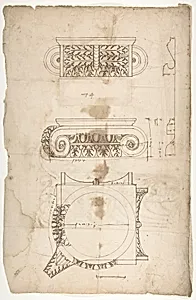
Temple of Portonus, capital, elevations and plan (recto) Unidentified, capital, elevation (verso)
early to mid-16th century
Medium
Dark brown ink, black chalk, and incised lines
Dimensions
sheet: 17 3/16 x 11 1/4 in. (43.7 x 28.5 cm)
Classification
Drawings|Ornament & Architecture
Department
Drawings and Prints
Museum
Metropolitan Museum of Art, New York, NY
Credit
Purchase, Rogers Fund, Joseph Pulitzer Bequest, and Mark J. Millard Gift, 1968
Accession Number
68.769.36
Rights
Public Domain
Tags
Art Historical Context
This exquisite 16th-century drawing, created by an anonymous French artist captures the architectural details of the ancient Temple of Portunus—a well-preserved Roman Republican temple in Rome dedicated to the god of ports and keys. The recto features precise elevations and a plan of a capital, alongside related elements, while the verso shows an unidentified capital elevation. Dating to the early to mid-0s, it reflects the Renaissance passion for rediscovering classical antiquity, as French scholars and artists traveled to Italy to measure and sketch Roman ruins for inspiration in modern design. Rendered in dark brown ink, black chalk, andised lines on a sheet measuring 17 3/16 x 11 1/4 inches, the work showcases meticulous drafting techniques. Incised lines—scratched into the surface—likely aided in transferring the design to another surface, a common practice for architects and stonemasons. This combination of media allowed for fine shading, sharp outlines, and accurate proportions, emphasizing the Corinthian-inspired volutes and acanthus leaves typical of Roman capitals. Housed in the Metropolitan Museum of Art's Drawings and Prints department, this piece highlights the era's architectural revival, bridging ancient Rome with French Renaissance ornamentation. It offers visitors a window into how such studies fueled the grandeur of châteaux and cathedrals, blending historical precision with artistic ingenuity.