
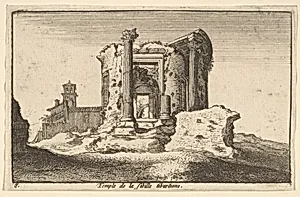
Temple of the Tiburtine Sybil, from "Roman Ruins"
Medium
Etching; second state of two
Dimensions
Sheet: 2 11/16 × 4 3/16 in. (6.9 × 10.7 cm)
Classification
Prints
Department
Drawings and Prints
Museum
Metropolitan Museum of Art, New York, NY
Credit
Purchase, Joseph Pulitzer Bequest, 1917
Accession Number
17.50.17-395
Rights
Public Domain
Tags
Art Historical Context
This delicate etching captures the weathered remains of the Temple of the Sibyl in Tivoli, Italy, a celebrated ancient Roman structure perched above cascading waterfalls. Created in 1650 by Wenceslaus Hollar after a design by Flemish painter Sebastiaen Vrancx, the print belongs to the series “Roman Ruins.” Hollar’s precise etching technique—here in its second state—renders crumbling columns and overgrown masonry with remarkable clarity, inviting viewers to appreciate both the grandeur and fragility of classical antiquity. During the seventeenth century, images of Roman ruins circulated widely through prints, shaping European fascination with the classical past. Though small in scale, measuring just under three by four inches, this work exemplifies how etchings democratized access to distant monuments for collectors and scholars. The collaboration between Vrancx’s compositional vision and Hollar’s meticulous line work highlights the period’s growing interest in topographical accuracy paired with romantic nostalgia. Housed today in the Metropolitan Museum of Art, the print reflects the enduring cultural importance of ruins as symbols of time’s passage and artistic inspiration. Its acquisition through the Joseph Pulitzer Bequest underscores the museum’s commitment to preserving such intimate records of historical imagination.
About the Artist
Wenceslaus Hollar|Sebastiaen Vrancx · 1607–1677
Wenceslaus Hollar (1607-1677) was a prolific Bohemian etcher who became one of the most accomplished printmakers of the seventeenth century. Born in Prague, he trained under Matthäus Merian in Frankfurt before entering the service of Thomas Howard, Earl of Arundel, in 1636. Hollar spent most of his career in England, where he produced approximately 2,740 etchings documenting an extraordinary range...