
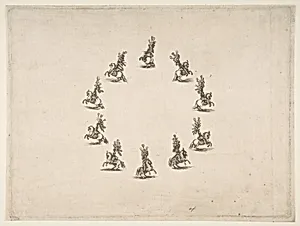
Ten Cavaliers Forming a Circle
Medium
Etching
Dimensions
Plate: 8 11/16 × 11 5/8 in. (22 × 29.5 cm) Sheet: 8 15/16 × 12 1/16 in. (22.7 × 30.6 cm)
Classification
Prints
Department
Drawings and Prints
Museum
Metropolitan Museum of Art, New York, NY
Credit
The Elisha Whittelsey Collection, The Elisha Whittelsey Fund, 1967
Accession Number
67.542.11
Rights
Public Domain
Tags
Art Historical Context
In the bustling world of 17th European printmaking, Stefano della's *Ten Cavaliers Forming a Circle (1652) stands as a dynamic etching that captures the grace and energy of equestrian prowess. This Italian artist, active during the Baroque era, was celebrated for his intricate, small-scale prints that brought scenes of military life, festivals, and parades to life. Working primarily in Florence and Paris, della Bella drew inspiration from masters like Jacques Callot, producing over 1,000 etchings known for their fluid lines and vivid detail. The etching's subject—ten cavaliers arranged in a precise circle on horseback—highlights the artistry of synchronized horsemanship, a popular motif reflecting the era's fascination with cavalry displays and courtly spectacles. Della Bella's etching technique, using acid to bite fine lines into a metal plate, allowed for remarkable precision in rendering the horses' musculature and the riders' flowing garments, creating a sense of motion within the compact plate size of 8 11/16 × 11 5/8 inches. This medium democratized art, making high-quality reproductions accessible beyond oil paintings. Housed in the Metropolitan Museum of Art's Drawings and Prints department, this work from The Elisha Whittelsey Collection exemplifies della Bella's mastery in evoking Baroque dynamism. Visitors can appreciate how it freezes a fleeting moment of harmony amid the age's turbulent wars and pageantry.
About the Artist
Stefano della Bella · 1610–1664
Stefano della Bella (1610-1664) was one of the most prolific and versatile printmakers of the Italian Baroque period, leaving behind 1,052 prints and several thousand drawings that captured the vivid essence of 17th-century European life. Born in Florence on May 18, 1610, to a family of artists, he trained initially as a goldsmith before studying painting under Cesare Dandini and etching under Rem...