
Tenebrae Candelabra
c. 1936
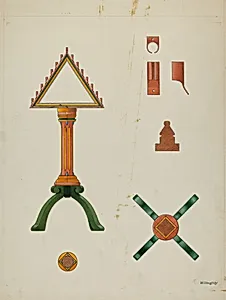
Medium
watercolor, colored pencil, pen and ink, and graphite on paper
Dimensions
overall: 35 x 24.4 cm (13 3/4 x 9 5/8 in.) Original IAD Object: Scale 1"=1'. Details: 6"=1'.
Classification
Index of American Design
Department
CG-W
Museum
National Gallery of Art, Washington, D.C.
Credit
Index of American Design
Accession Number
1943.8.6597
Rights
Public Domain
Art Historical Context
**Tenebrae Candelabra** is a meticulously rendered drawing by David P. Willby, created around 1936 as part of the Index of Design (IAD). ambitious WPA Federal Art Project (1935–1942) commissioned artists across the U.S. to everyday American folk art, crafts, and decorative objects, preserving cultural heritage the Great Depression. Willoughby's work captures a traditional candelabra in Tenebrae—Catholic rituals marking the final days of Holy Week, where candles are extinguished to symbolize Christ's passion. Housed in the National Gallery of Art's collection, it exemplifies the IAD's mission to celebrate vernacular design. Executed in watercolor, colored pencil, pen and ink, and graphite on paper (35 x 24.4 cm), the piece employs precise scales—1 inch to 1 foot overall, with details at 6 inches to 1 foot—to create an accurate, scaled representation. This multi-medium technique allowed for vibrant color, fine lines, and subtle shading, highlighting the candelabra's intricate craftsmanship, likely featuring tiered arms and symbolic motifs rooted in colonial or early American liturgical traditions. As a CG-W department artifact, **Tenebrae Candelabra** underscores the IAD's role in bridging art and history, offering visitors a window into America's religious and artisanal past. Its detailed fidelity not only educates but evokes the solemn glow of Tenebrae ceremonies, reminding us of design's power to illuminate cultural stories.