
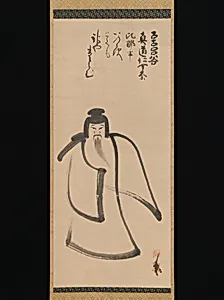
近衛信尹筆 渡唐天神図|Tenjin Traveling to China
late 16th century
Medium
Hanging scroll; ink on paper
Dimensions
Image: 38 7/16 × 16 13/16 in. (97.7 × 42.7 cm) Overall with mounting: 72 1/16 × 17 13/16 in. (183 × 45.3 cm) Overall with knobs: 72 1/16 × 19 13/16 in. (183 × 50.4 cm)
Classification
Paintings
Culture & Period
Japan · Momoyama period (1573–1615)
Department
Asian Art
Museum
Metropolitan Museum of Art, New York, NY
Credit
Mary Griggs Burke Collection, Gift of the Mary and Jackson Burke Foundation, 2015
Accession Number
2015.300.72
Rights
Public Domain
Tags
Art Historical Context
In the late 16th century, Japan's dynamic Momoyama period (1573–1615), court noble and master calligrapher Konoe Nobutada created *Tenjin Traveling to China a captivating hanging scroll in ink on paper. Measuring nearly 38 by 17 inches in its image area, this work illustrates a legendary scene from the life of Sugawara no Michizane, deified as Tenjin, the Shinto god of scholarship and poetry. Depicting Tenjin's miraculous spiritual voyage to Tang-dynasty China—part of folklore surrounding his exile and posthumous exoneration—the painting blends fluid calligraphy with evocative imagery, showcasing Nobutada's signature bold, angular brushwork. Hanging scrolls like this were prized in Japanese elite circles for seasonal display, unrolled to reveal their full splendor during tea ceremonies or scholarly gatherings. Nobutada's technique, rooted in his aristocratic training, exemplifies Momoyama ink painting's emphasis on expressive minimalism, where sparse lines convey motion, divinity, and cultural reverence. The meter's precise monochrome palette highlights the era's shift toward dramatic, personal artistry amid samurai rule and castle-building fervor. A gem from the Mary Griggs Burke Collection at the Metropolitan Museum of Art, this scroll invites visitors to ponder Tenjin's enduring role as patron of learning, reminding us of Japan's rich fusion of history, myth, and masterful ink traditions.
About the Artist
Konoe Nobutada · 1565–1614
Japanese, 1565–1614