
Tenor Geige
Unknown Artist
ca. 1600
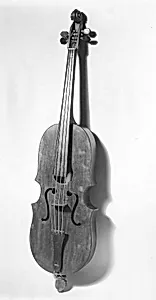
Medium
Wood
Classification
Chordophone-Lute-bowed-unfretted
Culture
Italian
Department
Musical Instruments
Museum
Metropolitan Museum of Art, New York, NY
Credit
The Crosby Brown Collection of Musical Instruments, 1889
Accession Number
89.4.2230a, b
Rights
Public Domain
Art Historical Context
Step into the Renaissance world of sound with the *Tenor Geige*, a rare Italian bowed string instrument crafted around 1600 from fine wood. This tenor-sized fiddle, or *Geige* in period terms, belongs to the chordophone-lute—unfretted for smooth, expressive glissandos and subtle pitch variations. Measuring larger than a modern violin but smaller than a viola da gamba, its elegant curves and sound holes reflect the exquisite Italian lutherie tradition emerging in places like Cremona, even if the maker remains anonymous. Historically, the *Tenor Geige* played a vital role in early consort music, blending with soprano and bass versions to create rich polyphonic ensembles for courts and chambers across Europe. Dating to circa 1600, it bridges medieval fiddle traditions and the violin family's evolution, showcasing woodworking techniques like precise joinery and varnish application that ensured resonance and durability. Part of the renowned Crosby Brown Collection at The Metropolitan Museum of Art since 1889, this instrument offers a tangible link to the vibrant soundscape of the Baroque era's dawn. Today, it invites us to imagine dances, madrigals, and improvisations that filled Italian palaces, highlighting music's power as an artistic medium in its own right.