
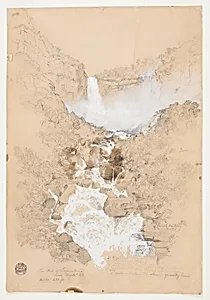
Tequendama Falls near Bogotá, Colombia
June 20-30, 1853
Medium
landscapes
Classification
landscapes
Department
Smithsonian Collection
Museum
Smithsonian American Art Museum
Credit
Gift of Louis P. Church
Accession Number
1917-4-260
Rights
Public Domain
About this artwork
Research in Progress
Art Historical Context
Frederic Edwin Church, a leading figure of the Hudson River School, captured the majestic Tequendama Falls near Bogotá, Colombia, in this vibrant landscape from June 20-30, 1853. Painted on-site during his first expedition to South America, the work showcases Church's masterful ability to render nature's sublime power. The Hudson River School emphasized the grandeur of the American wilderness, but Church expanded this vision globally, drawing inspiration from explorer Alexander von Humboldt's romantic descriptions of equatorial landscapes. Completed in just ten days, this oil sketch (now housed in the Smithsonian American Art Museum's Smithsonian Collection) exemplifies Church's plein air technique—working directly from nature to capture fleeting light and atmospheric effects. Its dynamic composition, with mist-shrouded cliffs and roaring waters, conveys awe and the untamed beauty of the New World, reflecting 19th-century American fascination with exotic locales amid Manifest Destiny ideals. Gifted by Church's son, Louis P. Church, this piece highlights the artist's role in elevating landscape painting to high art. Though research continues, it remains a testament to Church's precision and passion, inviting visitors to ponder humanity's place amid nature's wonders.