
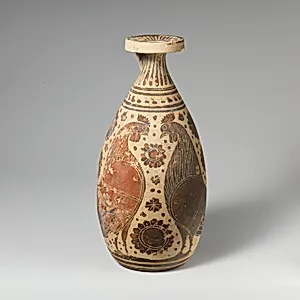
Terracotta alabastron (perfume vase)
Unknown Artist
ca. 575–550 BCE
Medium
Terracotta
Dimensions
H. 9 1/8 in. (23.2 cm)
Classification
Vases
Culture & Period
Greek, Corinthian · Late Corinthian
Department
Greek and Roman Art
Museum
Metropolitan Museum of Art, New York, NY
Credit
Rogers Fund, 1941
Accession Number
41.162.57
Rights
Public Domain
Tags
Art Historical Context
This delicate terracotta alabastron or perfume vase, hails from Late Corinthian Greece around 575–550 BCE, a vibrant period in the Archaic era when Corinth rivaled Athens as a pottery powerhouse. Standing just 9⅛ inches tall, it was designed for holding scented oils and perfumes, essential for grooming, rituals, and even burial offerings. Its slender, elongated form with a narrow neck made it perfect for pouring small amounts without spilling—a clever nod to everyday practicality in ancient households. Crafted in terracotta using the black-figure technique, a hallmark of Corinthian vases, the piece likely features lively rooster motifs in its friezes, showcasing the period's mastery of incised details and added purple and white highlights for vibrancy. Corinthian artists excelled in miniature animal scenes, packing dynamic energy into compact spaces, which made these vases highly prized exports across the Mediterranean. Today, this vase at the Metropolitan Museum of Art (acquired via the Rogers Fund in 1941) offers a window into Corinth's cultural flourishing—its fine pottery symbolizing trade, artistry, and the rooster's emblematic role in Greek life, perhaps evoking vigilance or agrarian vitality. A true gem of ancient ingenuity!