
Terracotta cinerary urn
Unknown Artist
2nd century BCE
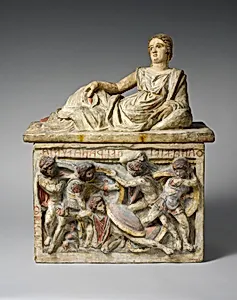
Medium
Terracotta
Dimensions
Height: 28 1/4 in. (71.8 cm) Other (Body): 29 x 20 1/2 x 11 3/4 in. (73.7 x 52.1 x 29.8 cm) Other (Lid): 12 1/2 x 11 1/4 x 11 5/8 in. (31.8 x 28.6 x 29.5 cm)
Classification
Terracottas
Culture & Period
Etruscan · Hellenistic
Department
Greek and Roman Art
Museum
Metropolitan Museum of Art, New York, NY
Credit
Purchase, 1896
Accession Number
96.9.223a, b
Rights
Public Domain
Tags
Art Historical Context
This striking terracotta cinerary urn 2nd-century BCE Etruria exemplifies the Hellenistic influence on Etruscan art, a period when the vibrant pre-Roman civilization of central Italy blended local traditions with dynamic Greek-inspired motifs. Crafted as a vessel for cremated ashes, it stands about 28 inches tall, with a separate lid, reflecting the Etruscans' widespread use of such urns in funerary rituals to honor the deceased. Acquired by the Metropolitan Museum of Art in 1896, it belongs to the museum's renowned Greek and Roman collection. The urn's surface likely features lively relief scenes of battles, soldiers, and women—common themes in Etruscan terracotta work that evoke epic narratives and the afterlife's heroic struggles. Terracotta, fired clay molded and detailed by hand, allowed artisans to achieve expressive figures with flowing drapery and dramatic poses, showcasing technical skill in capturing movement and emotion. These motifs not only celebrated martial valor but also underscored women's roles in mythology and daily life. Culturally, such urns highlight Etruscan innovation in funerary art, bridging everyday pottery techniques with monumental sculpture. They offer a window into a society that revered the dead through vivid storytelling, preserving legacies amid Rome's rising power. A testament to ancient ingenuity, this piece invites us to ponder the eternal dance of life, death, and valor.