
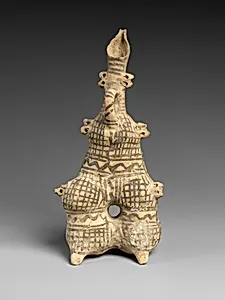
Terracotta composite jug
Unknown Artist
ca. 1800–1725 BCE
Medium
Terracotta
Dimensions
H. 8 1/8 in. (20.7 cm)
Classification
Vases
Culture & Period
Cypriot · Middle Cypriot II
Department
Greek and Roman Art
Museum
Metropolitan Museum of Art, New York, NY
Credit
The Cesnola Collection, Purchased by subscription, 1874–76
Accession Number
74.51.1050
Rights
Public Domain
Art Historical Context
This elegant terracotta composite jug hails from Cyprus during the Middle Cypriot II period, 1800–1725 BCE, a time when island communities thrived through advanced pottery and trade networks in the eastern Mediterranean. Standing just over 8 inches tall, its modest size belies its cultural role as a practical vessel, likely used for or pouring liquids like water, oil, or wine. Crafted from fired clay, terracotta was the medium of choice for Cypriot artisans, offering durability and allowing for intricate forms that mimicked more precious metal prototypes—hence the "composite" design, blending vessel shapes into a harmonious, functional whole. Artistically, this jug exemplifies the wheel-thrown techniques emerging in Bronze Age Cyprus, where potters achieved smooth surfaces and precise proportions without named masters. Its presence in the Metropolitan Museum of Art's Greek and Roman Art Department, part of the renowned Cesnola Collection acquired in the 1870s, underscores Cyprus's pivotal role as a cultural crossroads between Aegean, Near Eastern, and Levantine worlds. Simple yet sophisticated, it offers a window into daily life on this vibrant island, reminding us how everyday objects preserve ancient ingenuity. (198 words)