
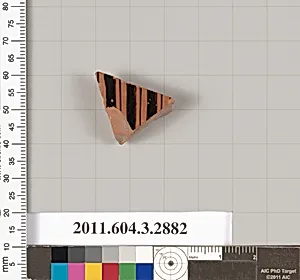
Terracotta fragment of a closed shape
Unknown Artist
6th/5th centuries BCE
Medium
Terracotta
Classification
Vases
Culture & Period
Greek, Attic · Archaic
Department
Greek and Roman Art
Museum
Metropolitan Museum of Art, New York, NY
Credit
Gift of Dietrich von Bothmer, Distinguished Research Curator, Greek and Roman Art, 2011
Accession Number
2011.604.3.2882
Rights
Public Domain
Art Historical Context
This delicate terracotta fragment from a closed-shape vase hails from Attic Greece during the Archaic period (6th–5th centuries BCE), a time when pottery craftsmanship reached extraordinary heights. Produced in Athens, the epicenter of Greek ceramic innovation, such vases—likely a lekythos for oils or an amphora for storage—were essential to daily life, rituals, and trade. Wheel-thrown and fired in kilns to achieve a warm reddish hue, these vessels often featured black-figure or emerging red-figure decoration, showcasing figures from mythology, daily scenes, or geometric motifs that reflected the era's artistic evolution. Though only a fragment survives, it offers a glimpse into the technical mastery of Attic potters, whose wares were exported across the Mediterranean, spreading Greek culture. The Archaic style emphasized stylized forms, precise incision work, and glossy slips, bridging the rigid geometry of earlier periods with the naturalism of the Classical age to come. Donated to the Metropolitan Museum of Art in 2011 by esteemed curator Dietrich von Bothmer, this piece underscores the enduring value of even small artifacts in piecing together ancient narratives. Pause here in our Greek and Roman galleries and marvel at how such humble terracotta endures, whispering tales of ancient hands and hearths.