
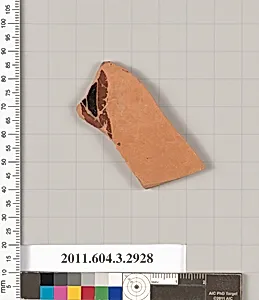
Terracotta fragment of a closed shape
Unknown Artist
575–540 BCE
Medium
Terracotta
Classification
Vases
Culture & Period
Greek, Attic · Archaic
Department
Greek and Roman Art
Museum
Metropolitan Museum of Art, New York, NY
Credit
Gift of Dietrich von Bothmer, Distinguished Research Curator, Greek and Roman Art, 2011
Accession Number
2011.604.3.2928
Rights
Public Domain
Art Historical Context
This terracotta fragment from a closed-shape vase, dating to 575–540 BCE, a glimpse into the vibrant of Archaic Attic pottery. Crafted in ancient Greece during the height of Athens' artistic flowering, closed shapes like amphorae or lekythoi were essential for storing oils, perfumes, or wine. Though only a fragment survives, it exemplifies the durability and everyday utility of terracotta—fired clay that allowed mass production while supporting intricate decorations. Attic vases from this era are renowned for pioneering the black-figure technique, where figures were incised into a glossy black slip before firing, revealing red clay beneath. This method captured myths, athletes, and daily life, serving as both functional objects and cultural exports that spread Greek influence across the Mediterranean. Our piece, from an unknown workshop, reflects the period's experimentation and mastery, bridging the geometric patterns of earlier styles with the narrative sophistication that defined Archaic art. Generously gifted to the Metropolitan Museum of Art in 2011 by Dietrich von Bothmer, a leading scholar of Greek and Roman art, this fragment underscores the value of even small survivals. They help reconstruct lost vessels, revealing techniques and tastes of a society on the cusp of classical greatness. Pause here to imagine it whole, alive with ancient stories.