
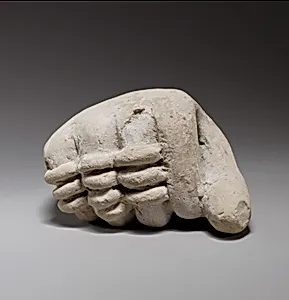
Terracotta fragment of a hand
Unknown Artist
5th–4th century BCE
Medium
Terracotta
Dimensions
H. 2 1/2 in. (6.4 cm) length 4 3/4 in. (12.1 cm)
Classification
Terracottas
Culture & Period
Cypriot · Cypro-Classical
Department
Greek and Roman Art
Museum
Metropolitan Museum of Art, New York, NY
Credit
The Cesnola Collection, Purchased by subscription, 1874–76
Accession Number
74.51.1461
Rights
Public Domain
Tags
Art Historical Context
This delicate terracotta fragment, depicting a finely modeled hand, hails from ancient Cyprus during the Cypro-Classical period (th–4th century). Measuring just 2½ inches high and 4¾ inches long, it is a modest survivor from a larger sculpture, likely a votive figure or statue offered at a sanctuary. Part of the Metropolitan Museum of Art's renowned Cesnola Collection—acquired through public subscription in 1874–76—this piece exemplifies the craftsmanship of Cypriot artisans blending local traditions with influences from Greece and the Near East. Terracotta, or fired clay, was a favored medium in Cypriot art for its affordability and durability, allowing widespread production of religious figurines and architectural decorations. The hand's naturalistic pose and detailed fingers suggest a high level of skill, possibly representing a gesture of offering, prayer, or divine authority common in Cypro-Classical votives. Such fragments offer glimpses into daily rituals and artistic innovation on the island, a vibrant crossroads of Mediterranean cultures. Today, this artifact invites us to ponder the lives of ancient Cypriots, whose terracotta works filled temples with devotion. Though incomplete, it captures the period's artistic vitality, preserved for modern eyes in the Met's Greek and Roman Art department.