
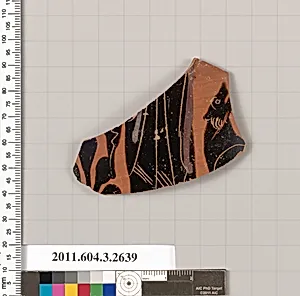
Terracotta fragment of a neck-amphora
Unknown Artist
third quarter of the 6th century BCE
Medium
Terracotta
Classification
Vases
Culture & Period
Greek, Attic · Archaic
Department
Greek and Roman Art
Museum
Metropolitan Museum of Art, New York, NY
Credit
Gift of Dietrich von Bothmer, Distinguished Research Curator, Greek and Roman Art, 2011
Accession Number
2011.604.3.2639
Rights
Public Domain
Art Historical Context
This terracotta fragment from a neck-amphora, to the third quarter of the 6th century BCE offers a glimpse into the vibrant of Archaic Attic Greek pottery. Produced in Athens during a golden age of vase-painting, neck-amphorae were practical two-handled jars designed for storing and transporting olive oil or wine—staples of ancient Greek life. As a fragment, it survives from what was likely a finely crafted vessel, showcasing the technical mastery of anonymous Attic workshops. Attic potters of this era pioneered the black-figure technique, firing clay with a glossy black slip to create silhouettes of figures, myths, or daily scenes, then incising details for vivid contrast. Though the specific imagery on this piece is partial, it exemplifies the Archaic style's dynamic compositions and narrative flair, which influenced art across the Mediterranean. These vases were not just utilitarian; they served as cultural exports, spreading Greek myths and aesthetics to Etruscans, Persians, and beyond. Gifted to the Metropolitan Museum of Art in 2011 by renowned scholar Dietrich von Bothmer, this fragment highlights the enduring scholarly passion for ancient ceramics. It invites us to ponder the hands that shaped it millennia ago, bridging our world to Archaic Greece's innovative spirit.