
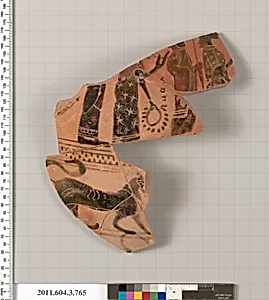
Terracotta fragment of a neck-amphora (jar)
Unknown Artist
second quarter of the sixth century BCE
Medium
Terracotta
Classification
Vases
Culture & Period
Greek, Attic · Archaic
Department
Greek and Roman Art
Museum
Metropolitan Museum of Art, New York, NY
Credit
Gift of Dietrich von Bothmer, Distinguished Research Curator, Greek and Roman Art, 2011
Accession Number
2011.604.3.765
Rights
Public Domain
Art Historical Context
This terracotta fragment from a neck-amphora, to the second quarter of the sixth century, offers a glimpse into the vibrant of Archaic Attic pottery. Crafted in ancient Greece's Attica region, neck-amphorae were two-handled jars used storing and transporting olive oil, wine, or other valuables—essential items in daily life, trade, and religious rituals. As a fragment, it survives from a once-complete vessel highlighting the fragility of these ancient artifacts and the skill of Athenian potters who produced them in vast workshops. In the Archaic period (c. 600–480 BCE), Attic vases like this one marked a golden age of black-figure technique, where artisans incised figures into slip-coated clay before firing, creating stark contrasts of black silhouettes against the red-orange terracotta body. Though the specific imagery on this piece is not detailed, such amphorae often featured mythological scenes, athletes, or daily pursuits, reflecting Greek values of heroism, beauty, and symmetry. These vessels were not just functional; they were exported across the Mediterranean, spreading Athenian culture and artistry. Generously gifted to the Metropolitan Museum of Art in 2011 by Dietrich von Bothmer, a renowned curator of Greek and Roman art, this fragment invites us to ponder the anonymous hands that shaped it over 2,500 years ago—hands that bridged utility and aesthetics in one of antiquity's most influential ceramic traditions.